"The body is the harp of the soul. It is yours to bring forth from it sweet music or confused sounds" Kahlil Gibran

Tuesday, July 19, 2011

The most rewarding thing I have done here.

So, what is my job here?

I have been trekking now for about two weeks. In that time I have held a week of business training with the women of Fass.  I tried in Wolof the best I could, but my counterpart Malik was my primary crutch for saying complex things as it is very difficult to explain complex ideas in a language that has a limited vocabulary.  

We want to train these women in business - savings, credit, debit, supply, demand, business planning, and employment. This is so that they can start their own business with the equipment that IRD is going to provide them. Many of the things we want to train these women on have never been explicitly explained despite the fact these women may already know much about business from their day to day selling in the market.  The difficulty is how to help them realize they know some of these things already, so our business trainings were essentially me and Malik showing the village images of what business looks like in their day to day life. 

To my surprise and delight this was the most successful and fulfilling work I have done since I have arrived.  The women had made acceptable progress on the building and held a meeting where we did our business sessions.  They were excited, engaged, and able to come to many conclusions on their own about how many people fighting over one loaf of bread would cause the price of it to rise. 


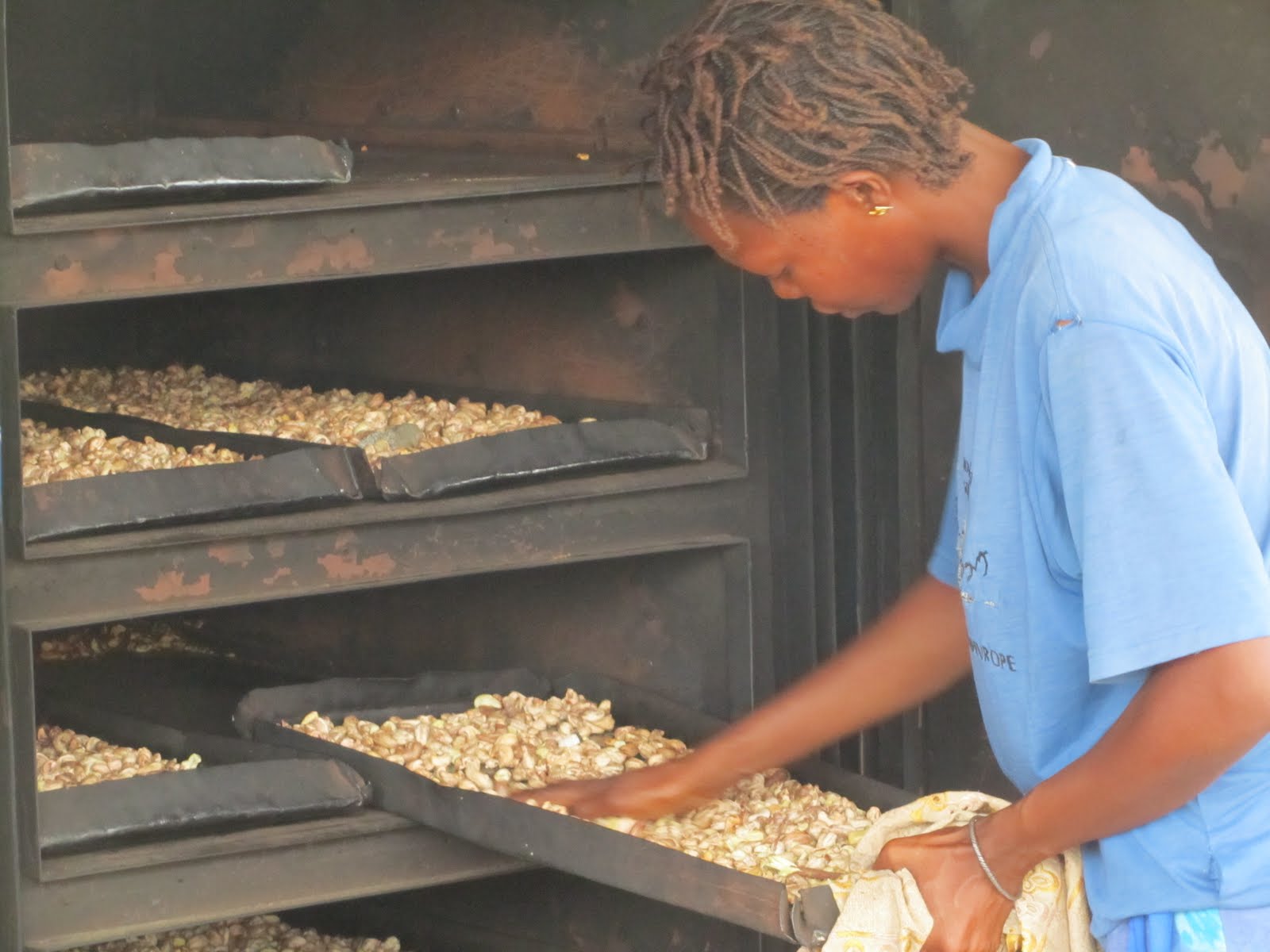
After this trek and the weekend mentioned in Water with a Hint of Goat, our women and a few of my IRD coworkers trekked to Senegal to see how women process cashew there.  A 12 hour road trip later, we sat, watched, and talked to women who had been processing cashew their whole lives. Let me reiterate, everything about the cashew is difficult to manage even with $100,000 dollars of processing equipment; these women have been doing almost all of it by hand: cooking it in a wood fired oven to soften the shell, cutting it by hand, putting it back in the wood fired oven to roast, and then peeling the outer covering off the nut.  Listening to how they managed their business will hopefully help these women construct their own business in a way that runs efficiently.  The BIG problems that must be faced, is the concepts of time, charity, and responsibility.

Malik, my IRD counterpart who works in the villages.
Time – In the Gambia, not everyone really knows what time it is due to lack of watches and literacy, and everything runs very slowly, sometimes people are late by days.  Problems like this in reference to business are obvious, if you have sign a contract saying you will provide cashew nuts by Wednesday being a few days late is a big deal.  Here if you say there is a 4pm meeting, people show up at 6pm.

Moise, my manager, on our trip in Senegal, explaining some of the cashew business and asking questions of the women who work there.
Charity- In the Gambia things run on sharing and credit.  People lend out things, forgive others of their debts, and ask the more fortunate for hand outs.  To the extreme of Muslim concepts of giving out charity (which is a huge part of the religion), this instead breeds a system of not paying for things on credit, laziness, and incessant borrowing.  We are really afraid that others in the village may try to just ruin the business inadvertently by constantly asking for some of the money coming into the village through this new business.
Peeling the outer cover off the nut after it has been cooked, cut, and roasted.

Responsibility- Here the responsibility is to the family and community to the extreme.  In a very collectivist way, people here miss meetings and business opportunities because there is a naming ceremony in the village for the consistent stream of babies here that are born in high volumes, and they will not come if the lunch has not finished cooking or they get lost in the cleaning or daily plowing.

A woman prepares nuts to go into the oven

We are trying to impress that things must have consequences because the business will fail if your workers are two hours late, hand out your money, or just don’t show up. In a society where these values have been ingrained from birth, it will be difficult.


Checking to see if the nuts are evenly cooked

I am coming to realize I am one of the luckiest Peace Corps volunteer in world; my assignment to an NGO as an agribusiness consultant gives me two years of experience internationally in business and non-profit preparing me perfectly for my next step in life.  At the moment, my current plan is for going back for some combination of a MBA and/or master’s degree in international development.  I am learning so many things about importing and exporting, supply chain management, and small scale entrepreneurship. I just want to say, that despite the cultural and social challenges, Peace Corps has been the best choice of my life. Thank you everyone back home for keeping in touch and being so supportive of my journey.


Spend the day in Peace


Friday, July 15, 2011

Water… with a hint of Goat


When I pulled out the first bright yellow bidong of water from Scott’s well, I immediately knew something was amiss.  The water was grey and smelled of a rotting swamp where mass burial has occurred.

 “Oh my, what is that smell?” I exclaimed in disgust.
“It’s a goat.” Scott replied.

Scott explained that a few weeks ago well no one was around, a goat made its way through the garden fence and probably became curious as to the strange concrete structure that stood a foot above its own eye level.  It promptly launched itself up to see what was on top and discovered…nothing. Scott being on the boarder to Senegal lies far from the river and the water table is very deep.  So the goat had about 40 meters in free fall to contemplate why goats can’t fly.  The result?  Bits of hair, fur, and rotting goat skin pulled up continually for weeks.  It took a few days to fish the goat out with cage like contraption but by then the goat had really funked up the water. 

Despite watering the garden with “Goat infused water” my time visiting my friend was enjoyable.  I pruned Cashew trees (with cheap machetes!), planted some pigeon peas, and disappointed a lot of the locals who hoped I spoke Fula (Scott lives in a Fula village) but could only produce the guttural Klingon verbage that is Wolof.  Here the people subsist off of rice, coos, baobob leaf, and when available small amounts of fish.  This reminds me that while I do not get some of the unique cultural benefits of living directly in the village with a host family, I do get a much greater level of nutrition that keeps away the vitamin and protein deficiency that many of my fellow village mates must deal with when consuming a dinner of coos moistened with water and a few bites of added fish. 
Scott's village
Said Small boy
I did bond with a small boy.  After hanging out with him for a few days he began begging me to use my camera...so I told him if he caught a goat he could use my camera.  A few minutes later goat in hand, I let him have the camera.  Not knowing what to take pictures of we had a goat photo shoot and maybe things got out of hand…

Step one catch goat
Step two add goat to every picture you take


This picture may come back to haunt me some day...
Scott, his host sister and cat "Carlos"


An even better picture when you sneak up from behind and add a goat...


Scott's compound, where his host sister pounds coos for dinner


Tiny Momodu always has food on his face and has the talent for high pitch screaming


Little girls everywhere carry full buckets of water on their water on their heads, they weigh perhaps 40  pounds

Scott's host mom
These pictures hopefully give a sense of village life aside from the goat pics. I hope that they help provide some experience of culture and emotion from a far away place.

I am exhausted from getting back from a trek to Senegal.  I am going to write a long post next week on my work as I have had a wonderful and rewarding time helping women in the village learn about business, while myself continuing to learn about the culture and the cashew.

We spend the day in peace,
(Nu Endoo Chi Jamma)

Sunday, June 26, 2011

The Future is Face


         Here on a river delta on the corner of a continent I see the only change of season The Gambia has.  Rain, three months of it cornered by unbearable humidity and heat, and other than that, dryness.  Gambia is the seasonal desert, on the boarder of the Sahara; this rain is the only reprieve from the desert that lies beyond.  There is therefore little to mark time.  Weeks may pass on the same endless sunny day.  There are many here who do not know their birthday or even their actual age.  I was told that Africa was home to 4,200 languages and that only 3 of them have an actually have a word for future; lending to a lack of the concept of time.  In Wolof the word for future is the word for face.  If I want to say something will happen in the “future” I say, “it will come to face” as in it will come to your face soon (and past is the same word as back).  So cut down a tree today for firewood because the family must eat today.  There is little ability to save money and resources under in the endless day with no future.  Often daily survival is the task at hand, and the abstract idea of having to do this again later is not as pressing as what we will eat today. 

I felt this was a powerful picture of a kid trying to read a book upside down...
Do not give money or aid here, because I have seen as have many how it is squandered as a desert oasis that can be drank in one gulp and not preserved for the “future”. Generations of farmers are often not interested in our strange technology, or lectures on how to change.  They trust their family knowledge with the assurance that it has gotten them through every rainy season.  The future is what is faced and the desire to look beyond needs to be developed from within.   

(a great talk about why giving aid hurts often more than it helps)

The rain brings these guys...
Indeed this simple concept of no future has changed my life here.  I will not work for a non-profit in the “future” because there is no sustainability where funds from the rich countries are squanders and the results are most often unsustainable and even sometimes hurt the people in the dependence and expectations that it creates.  The Gambia, a truly impoverished and developing country where NGOs and non-profits are as numerous as the small children in the streets, often just float on donations and promises, distributing aid that is used to buy extravagances and in no way improves the situations or future of this country. 

People told me that they didn’t want to waste two years in sitting doing nothing in a foreign country when the clock was ticking on grad school or the never ending career ladder, but in the adventure of life, I have found that the shifting perspective of living in a developing country is what can make all the difference as to the path you choose, helping me in particular find a more certain first step.  Had I not done this, operating under my initial idealism I would have pursued grad school and jobs, and many years from now I would have discovered this flaw in my plan… and then way more than two years would have passed. 
The Chicken was not happy...
Please investigate the truth on the ground; you will find something much different than the altruistic theory which many intentions and aid is based on.  Here I sit listening to the rain, the definitive change of face, the one thing that signals new life and new harvest here, as the fields are ready to be flooded for rice, the farmers go to work

Cultural Runoff
Teaching children American values
There is fear and curiosity in ever child here about me.
(See previous post)
Even in the village, everyone has cell phones.  They ring constantly, destroying the idea that there is a place where the small villages of Africa are insulated from the influences of the outside world.  It this globalized society, even small kids who live in the village get Rihana and Justin Beiber from the small radios, and the old men try to give me what they believe are well informed opinions about a world they've never seen.  Many think the oustide world is much like theirs but with more money. And if America has more money they assume that we would do what they would do, have a bigger compound, have more animals to slaughter (one question asked of a volunteer was "how many cows were slaughtered at your friend's wedding back in the states?" after making a mental note of the number of steaks served, the volunteers guesstimate was about 3).  In this way we are very much the same. 

Now if we can  provide cell phones, cheap movies, and massive waste in aid spending... why can't we give quality education?  As mentioned before aid is not the way here, so please think about this...
A school master's desk in the Gambia who I visited


My Work in the Village


The President of NDARR cashew and a member and mason who is building a structure to house the cashew equipment
I have spent only a few days in Fass on the North Bank, but in my short time I held meetings with 3 different cashew growers associations.  The primary group is a group of women married to cashew farmers, it is them who produced these nuts
This is village processed cashew.
Delicious but not fit for the international market

This is what we want to change by giving them high quality equipment from India that I have worked on here my whole time, we hope to give these women jobs processing cashew nuts that are beautiful and white, and fit for consumption internationally. This will  hopefully bring sustainability and money into the village.


The challenges however are many.  On a daily basis, I have to convince myself that this can work.  I believe in these women, but I always feel like the cards are so stacked against them that they will fail. Everyday these women are burdened by child rearing, cleaning, gardening, cooking, and complete male domination that they have so little left despite the fact they give their all.  I am just so scared that they will not be able to contribute the buildings they need to house the equipment or be able to manage a business when they are illiterate and their husbands control the money.  It is so much stacked against them.


I go back to the village July 5th, I hope that they will have made financial progress and building progress... if not, we may have to pull out about 1/2 of our equipment.  I will keep you updated.


MR GOAT approves this message!


Monday, June 13, 2011

6 Months Later and I am off to the Village

Little Omar and the Tubobasaurus Rex ... I know I should stop scaring the children :)


Tiny Omar lives in a small house with his family.  Only a child, he fearlessly roams the compound.  That was until the scary white creature moved in next door… Now Omar scampers by the door, and whenever he sees this strange abomination he screams, cries, and runs away.  One day Tiny Omar (or Omar bundow as I call him in wolof) ventured up to the lair of the strange creature and began banging on the door.  His attempts to investigate seem to be going nowhere… until he hears a faint tapping. He looks to the window and sees the creature staring at him mimicking tiny claw like motions going “raar…raar” behold the Tubobasaurus Rex!


Tiny Omar screams in blood curdling terror and retreats. I pause in mid T-Rex mimicry and laugh.  I know that this will not help the problem but I have tried everything that you would try on a terrified rabbit to convince it you are not a vicious carnivore.  Now I figure I should just play the role.  Many kids here are terrified of my ghostly white appearance, many have never seen a white person before.  I have walked out of a compound after visiting for the first time to an entire yard of small children crying in fear at the horror which they see… I am an albino monster.


On a quick note Tubob to child relations go as follows, 


Stage 1...OH MY! WHAT IS THIS: The Baby stage - If they are babies, they just stare in wonder at me. 


Wow, look at this thing...


Stage 2 FEAR: The Omar stage- After some time, they become afraid of the white abomination 


Ok...what... are...you?
Stage 3 MINTY: The Minty stage - As mentioned earlier, after realizing that many white tourists give them things they run around saying minty or money. 
When Fear turns to give me Minty
At this stage they seem like robots, due to poor schooling where they only repeat English phrases.  They run around yelling "hello ... hello ... hello... how are you... how are you i am fine... hello i am fine... i am fine"


Strange robots that run off of candy...


My Double Life


Soon I will head off for the village.  Not living there full time, I instead will do what is now being called, extensive trekking... this is because I cannot have two sites technically, but for an indefinite period I will be heading up to the North Bank during the week to a town called Fass (or Fass Njaga Choi) to help promote our Cashew Enhancement Project by helping a large women's group up there learn about: 


1) What is business, and what are good business principles.  We have these large posters with drawing such as a man with many people fighting over a few small items in a shop, and a store owner with on one coming in as jumping off points for concepts such as Supply and Demand and proper business planning, timing, location


2) I will help them organize their own business processing cashews. With countless hours already spent in the office ordering cashew equipment from India, I will now help them learn about book keeping, balancing profit and loss, depreciation, and saving.
Some of the laminated posters we have made to help with
business training using examples they can relate to.


3) I will prepare and train them when the cashew equipment arrives. 


4) I will do this all in Wolof. This is going to need some translation help because it is one thing to explain what you are doing today, and quite another to explain the concept of depreciation. 


My trekking starts this Tuesday.  I will be up in the village getting to know the women, and figuring out which ones are most motivated and competent for positions of this new business they, with our help, want to create.


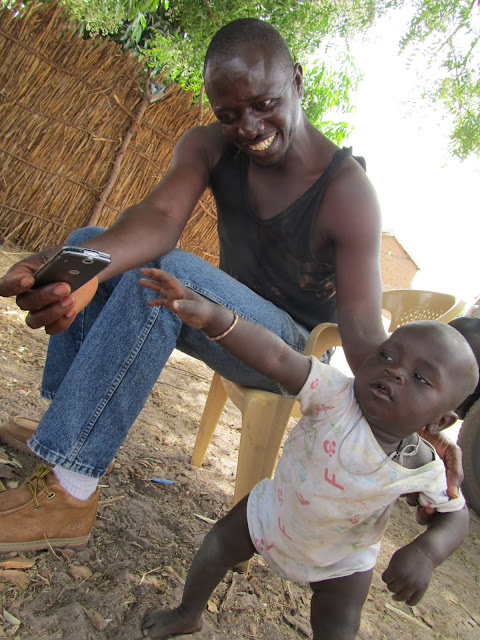
Here is the "guard " for IRD.  He basically helps open the door when the vehicles come in, sits, brews green tea, and is exceptionally friendly from what I think I can gather from his ancient mumbled Wolof.  The baby is the cleaning lady's child.  This was a great picture even though it has been done 1000 times before where the ancient man holds the new born. Now I just need to sell this to IRD because I have some great publicity shots.


My Rooster Revenge (chickens eating chickens)


So, in perhaps the most sinister way possible I realize that chickens have it both amazing and rough.  Amazing because they are happy here, they roam, they peck, they wake me up at 530 with their crowing.  I however saw a sight that made me both laugh and gave me great pause as to the oppression of the chicken here. 


I visited my host family in the village again last weekend, and they slaughtered a chicken.  It made a great lunch, but as our family ate with their hands outside from the communal food bowl they began discarding the bones of the chicken… The chickens in the yard came running, and fighting over the left over pieces of tendon, and meat sill left on their recently deceased relative.  It was a bizarre thing to watch chickens fighting over the remains of their mother, father, sister, brother that had been pecking in the yard that very morning.  The forced family cannibalism was bizarre, sad, and comical at the same time


What Peace Corps means... (a few thoughts after 6 months in The Gambia)


A large wedding ceremony I went to last weekend where they cooked for over 300 people using these giant pots
Peace Corps for everyone means something different, some people get placed in villages, cities, mostly developed, underdeveloped, and undeveloped countries.  For volunteers we wither end up with the wrong conditions, or by strokes of luck get placed in amazing conditions.  Often times it has little do with Peace Corps itself and more to do with factors beyond anyone’s control.  What links us though is the hardship, that no matter where you go you get a difficult task. As compiled from my fellow volunteers, in the Gambia these conditions include,
  1. Horrible reactions to malaria medications (causing lack of sleep, mood swings, vivid dreams)
  2. Being placed in villages where people are not welcoming and/or speak a variety of different languages
  3. Having unbearable heat rash from the 100+ degree days (day after day)
  4. Eating coos, dirt, and poop from poor hygiene and sand storms
  5. No vegatables from the lack of anything but coos/rice and onion sauce
  6. Incredibly over aggressive and threatening men who desire money from the men, and sex and money from the women
  7. Intense language barriers adjusting to dialects and mumbling 
  8. A complete loss of privacy due to this cultures' disregard for personal space
  9. Horrible medical conditions ie festering wounds, malaria, Guardia, parasites, worms, scabies, schistosomiasis, and endemic rabies (indeed we had one volunteer get bit by a dog here, and was almost evacuated on suspicion of being rabid)
Then there are the emotional barriers that come with being a Peace Corps volunteer, these include
This is a woman cooking whole pieces of cow with a few other veggies.  There was at one point a snout in the bucket... 
  1. Not seeing friends of family for extended periods of 2 years or more.
  2. Fearing that everyone you know is forgetting about you and/or moving on
  3. Trying to manage long distance relationships for some of us
  4. Complete identity crisis caused by everything familiar disappearing
  5. Watching the way the culture here treats families, women, children, and animal 
  6. Including the beating of women by husbands, the children by women and the animals by the children, usually in that hierarchy leading to cascading violence and intense situations for volunteers placed in these families.
  7. The way women are treated socially- they have little say in finances, undergo FGM, do most of the work, have multiple multiple children, having to their husbands take on as many as three extra wives, and undergo a severe lack of education.
  8. Being called "Tubob" white man/woman all the time, with the racial assumptions that go with.  2 weeks ago I was walking with some friends and a man offered a taxi, when I declined he replied with distaste, "Come on, you are a white man, you can afford it, take a taxi" 
  9. Putting up with long sleepless nights of lizards, rats,  roosters, 5:30am calls to prayer and above mentioned malaria medication insomnia.
  10. The love/hate relationship we have with Peace Corps.  We love the people and the mission... but with the paper work and oversight is sometimes a nightmare to deal with: site changes, harassment issues, monetary issues, and just about anything requires a pile of forms and indefinite waiting.
  11. Watching friends you make leave on consistent 6 month intervals with the arrival of new groups, implicitly lending to the idea that all friendships here with the exception of your own group have a shelf life
  12. Thinking that you will never be understood by people in America again because you have seen what it is like to completely integrate with a foreign culture to the point where you take on a new relationships with your ideas of poverty, happiness, consumerism, globalization, and all your possessions.
  13. The intense pain of the above mentioned illnesses
  14. The potential loss of a family member to illness without ever being able to say goodbye
  15. Family and friends getting married having children living and dying without you ever knowing until it shows up on facebook
*These views are not experiences I have personally had in all cases, but each one has been brought up by other volunteers as to some of the intense hardships that they face.  I am also not expressing any direct view on Peace Corps here, just combined observations and opinions


All combines to make each person's experience an incredible and unique representation of the Peace Corps experience.  Some experiences are just what a given person needs to succeed, grow, and help others, others are given a poor set of circumstances.  We lost a close friend to an early termination recently.  It makes me truly sad because she was a close friend. You compare circumstances in Peace Corps because everyone has such a different experience because of the situation they were placed in. In this way there will forever be people who do not like Peace Corps, justifiably so! and others who loved it justifiably so.  There cannot be comparisons, we are just a collection of people living in different countries around the world and trying to get by.  Some of us are given circumstances that should not be tolerated as they are not helping ourselves and others. 


However, if we are lucky and get the right set of circumstances where we can grow and help people, the sustained difficulties we live through become the life blood of the Peace Corps experience. And if the above mentioned factors sound harsh, I just wanted to make a point that the only way to understand who we are over here, is to know that we will be changed here more by the bad times than the good times. When we step off the plane 2 years from now, the slow adaptation to the above mentioned factors will change each of us beyond recognition. 


Me and my coworkers at IRD
 Spend the day in peace