"The body is the harp of the soul. It is yours to bring forth from it sweet music or confused sounds" Kahlil Gibran

Monday, August 22, 2011

Cape Verde in Pictures

Welcome to the largely pictorial account of our trip to Cape Verde.  The images are mostly chronological and captions give you an idea of our adventures.  For the most part though I am going to let the pictures do the talking. (I will also include the similarities and differences between Cape Verde and Gambia)  


Difference 1: Cape Verde Treats its dogs better

Mostly
Difference 2: No bumpsters on the beach


Similarity 1: Same undying love of Barack Obama on everything made for sale

Similarity 2: Women still carry everything on their heads

Difference 3: Everything is in Portuguese. But our collective Spanish sufficed most orders
Similarity 3: Still have thatched roves though not as many

Tired of listing them out... but they are also fishermen, their boats however are much prettier

Things needed for trip: Good travel companions - check!

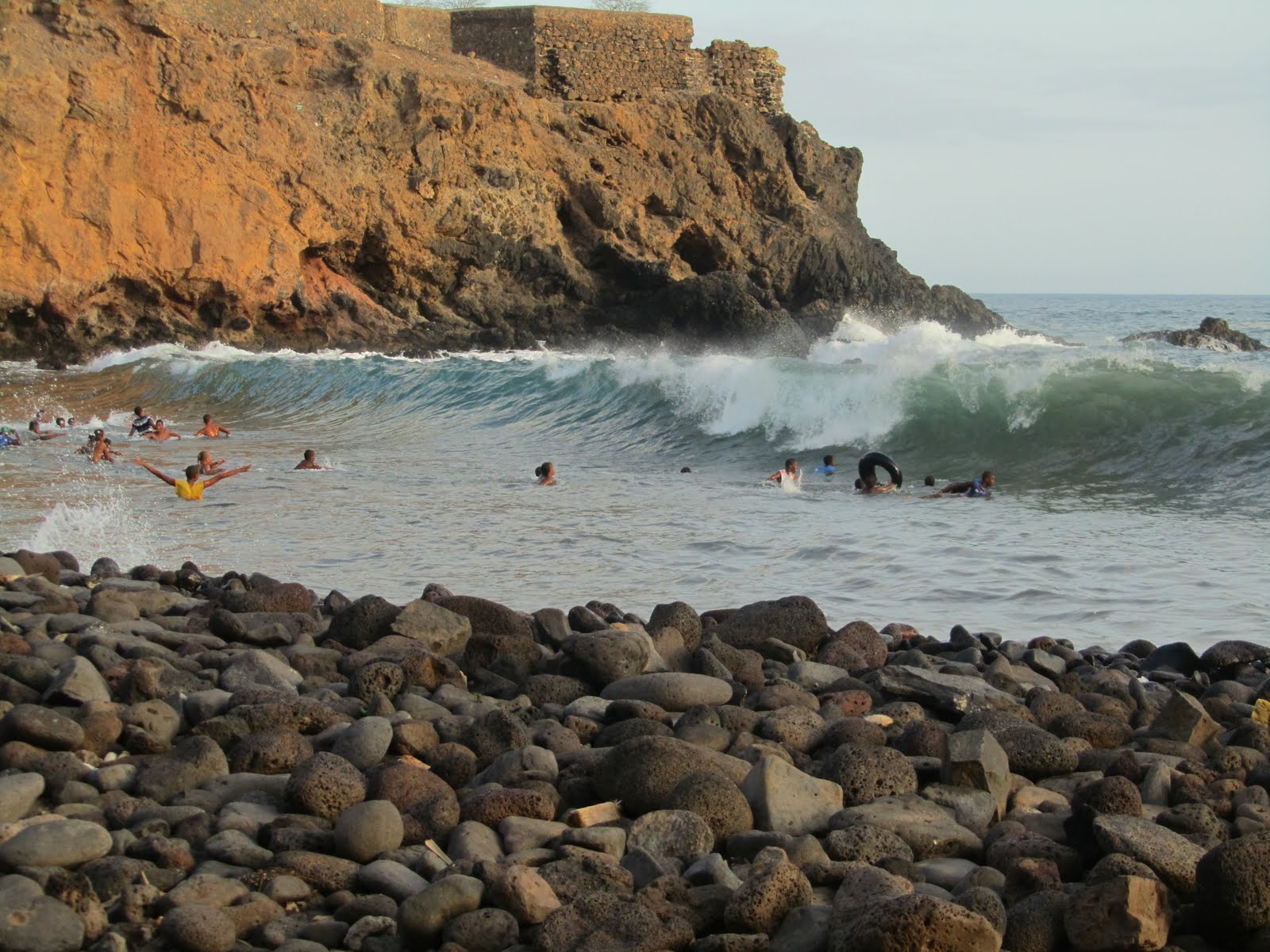
Cape Verde was stunningly beautiful everywhere. This is Mindelo.

The biggest thing that Cape Verde has that Gambia doesn't ELEVATION!

In our travels we spent the night with Peace Corps volunteers who lived and worked on a volcano in a pine forest
that is often above the clouds

This is the crater of an extinct volcano, inside lies a village of farmers who farm the still rich soil.

Ok, huge difference.  Cape Verde they built everything with rocks and even terraced the hills they farmed to prevent erosion.

Never seen before in the Gambia, behold: THE WOOLLY DONKEY! 

Our mountain Sherpa (a Peace Corps Volunteer named Scott) and Sharon.
Notice the beautiful cobblestone roads on the side of a cliff!

One of our magnificent hikes took us down the side of a vertical volcano face down through the clouds


Under the clouds, towns that farmed bananas, sugar cane, and coffee

A local cheese and grog maker had a side kick...
Grog is the national drink of sugar cane liquor that is brewed locally, it provides entertainment for the locals in the form of stumbling down steep volcanic cliffs


We went to see a local dojo of Capoeira martial artists.  Capoeira is a form of "dance fighting" popular in Brazil.  Cape Verde is also a big fan! 

We all enjoyed the finer things in life not found in Gambia... some it was wine. For me fresh coffee was everywhere!


We enjoyed food not seen or eaten by us in 8 months


On the ferry


The trip was an awesome invigoration for another round in the Gambia... Thanks for looking

Monday, August 8, 2011

Rain, Mud Wrestling, and Hard Labor In the Bush


Roughly 10 hours of navigating a ferry crossings, riding on vans with 10 sheep tied on the rough, and wandering through the streets of Basse.  I arrived upcountry in the midst of a drought and heat wave that is causing mass panic.  The only coincidence is that 30 minutes after I arrive we have the biggest downpour of the season, and me and some the other upcountry volunteers celebrate. 

Remy and I were soon engaged an intense Mud Wrestling match...
Add caption


 In the end... I was victorious. (not really we both pinned each other a few times but I posed on top of him while Abby kicked mud on him)

Add caption
Most fun experience in Gambia thus far!

Planting Cashew

This is Alagie
Alagie has one shirt.  It is a bright purple Colorado Rockies shirt; he bought it on the street for perhaps 75 cents.  I have told him the personal significance that this holds for me and my home team far away.  I tried to explain baseball to him: what “pitching” is, why they do it… the concept of hitting a ball with a stick… the concept of getting “out”. I think I failed royally, but Alagie encouragingly says to me “No, no.  I understand, I think I have seen this before.  Except, except, I think they called it something different. I think they called it 'tennis'."


Regardless of explaining abstract sports with him, Remy and I spent the last week upcountry trying to help Alagie cultivate his new land in the middle of the African bush.  This means that we are going to try and give him a sustainable orchard complete with cashew trees, Molina trees, and Moringa trees.  All this can be sold, used as food, and improve nutrition.  So the three of us embark out into the bush with planted baby cashew trees on our head, tools, and some rough marks on where to plant them.  For three days straight we work digging holes, chopping roots with machetes, and planting cashew. For a period we enhance our work by doing ten pushups for every cashew planted.  This lasts for a period until exhaustion sets in with Remy doing 230 pushups and myself only willing to do 130.  


Alagie probably the hardest working of us all did none, he also had no food, or water during the three days we planted as he was fasting for Ramadan, the things these people can endure amazes me.  

Alagie wants this land to support his only child, he speaks of wanting to send his kid through school and have a better life than him.  Alagie is very poor and malnourished but has the hardest working spirit I have ever seen. Sadly he is one of the only ones who is happy with the knowledge he is receiving from Peace Corps, most of the people sit under the bantaba (gathering place in the middle of the village with a roof for shade) and say “not today the sun is hot” whenever they are asked by my friend Remy if they want to learn and work on ways to improve their lives through beekeeping, sustainable tree harvesting, and gardening. Mostly they wonder why the white person isn't just giving them money.

In the end we mark, dig, and plant 70 cashew trees, and after office work, trainings in the village, and months near the ocean, it is invigorating to do hard labor in the African bush. What I had planned as a vacation up into the bush turned out to be a wonderful experience as to the differences among Peace Corps volunteers’ experiences.


Other things we did up there... 

1) Pounded Moringa leaves into a nutritious vitamin powder

Called the Miracle Tree, Moringa is full of vitamins and is a fast growing tree that people can harvest to improve their livelihoods
In his hut Remy encourages  his propane tanks to think positively
2) Cut wood to make into bee hives

In the future Remy hopes to have many bees hives on Alagie's land in hopes to demonstrate to others what can be done with a wood box

3) Went up to the only mountain around, read, and meditated on life

Sometimes a cave of reflection, Remy has written poetry all along the walls of his hut


4) Participated in making neem cream


Remy's closest volunteer Alex comes over to show the villagers how to boil down Neem leaves from the invasive tree to make a cream which acts as an insect replant to mosquitoes in the wet season. A very effective weapon against Malaria 


5) Saw a football tournament.


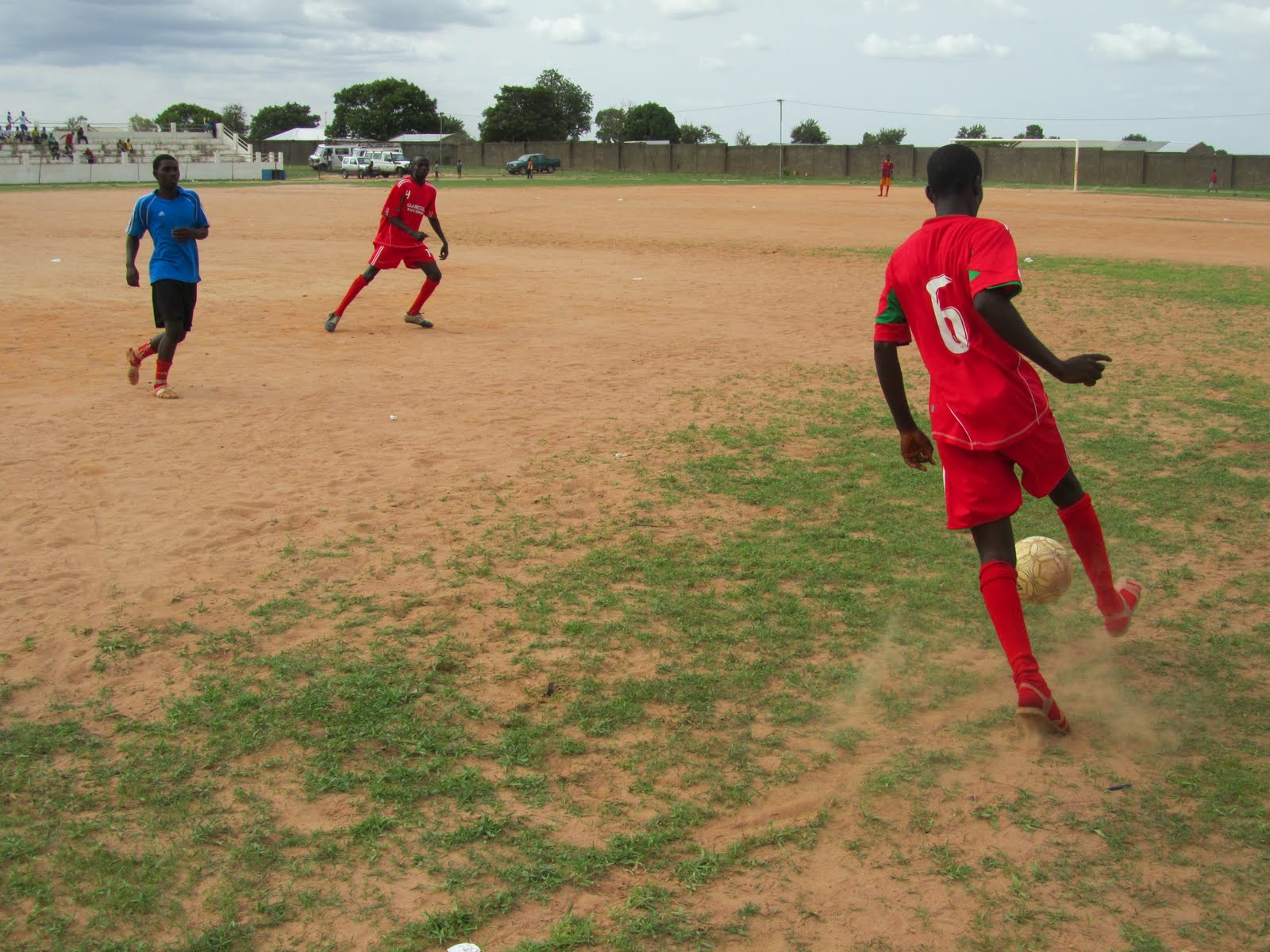
Gambia loves football. I just wish my camera's shutter was fast enough to catch the whole ball

Often with little money, Gambians place with plastic shoes, or sometimes just socks, as shoes are the most expensive part of a football outfit.

The Gambia Primarily a giant river delta means all the fields are made of river sand 


The winning town celebrates winning the tournament

 As part of a Peace Corps sponsored event in Farifenni, I went to watch the HIV/AIDS know your status tournament final between two North Bank teams.  It was a massive success and the culmination of the hard work of many volunteers

So I will now head off for a week vacation in the Cape Verde Islands, I hope to get some elevation and hike some volcanoes.  Until then thank you for reading and


 Spend the day in peace


Tuesday, July 19, 2011

The most rewarding thing I have done here.

So, what is my job here?

I have been trekking now for about two weeks. In that time I have held a week of business training with the women of Fass.  I tried in Wolof the best I could, but my counterpart Malik was my primary crutch for saying complex things as it is very difficult to explain complex ideas in a language that has a limited vocabulary.  

We want to train these women in business - savings, credit, debit, supply, demand, business planning, and employment. This is so that they can start their own business with the equipment that IRD is going to provide them. Many of the things we want to train these women on have never been explicitly explained despite the fact these women may already know much about business from their day to day selling in the market.  The difficulty is how to help them realize they know some of these things already, so our business trainings were essentially me and Malik showing the village images of what business looks like in their day to day life. 

To my surprise and delight this was the most successful and fulfilling work I have done since I have arrived.  The women had made acceptable progress on the building and held a meeting where we did our business sessions.  They were excited, engaged, and able to come to many conclusions on their own about how many people fighting over one loaf of bread would cause the price of it to rise. 


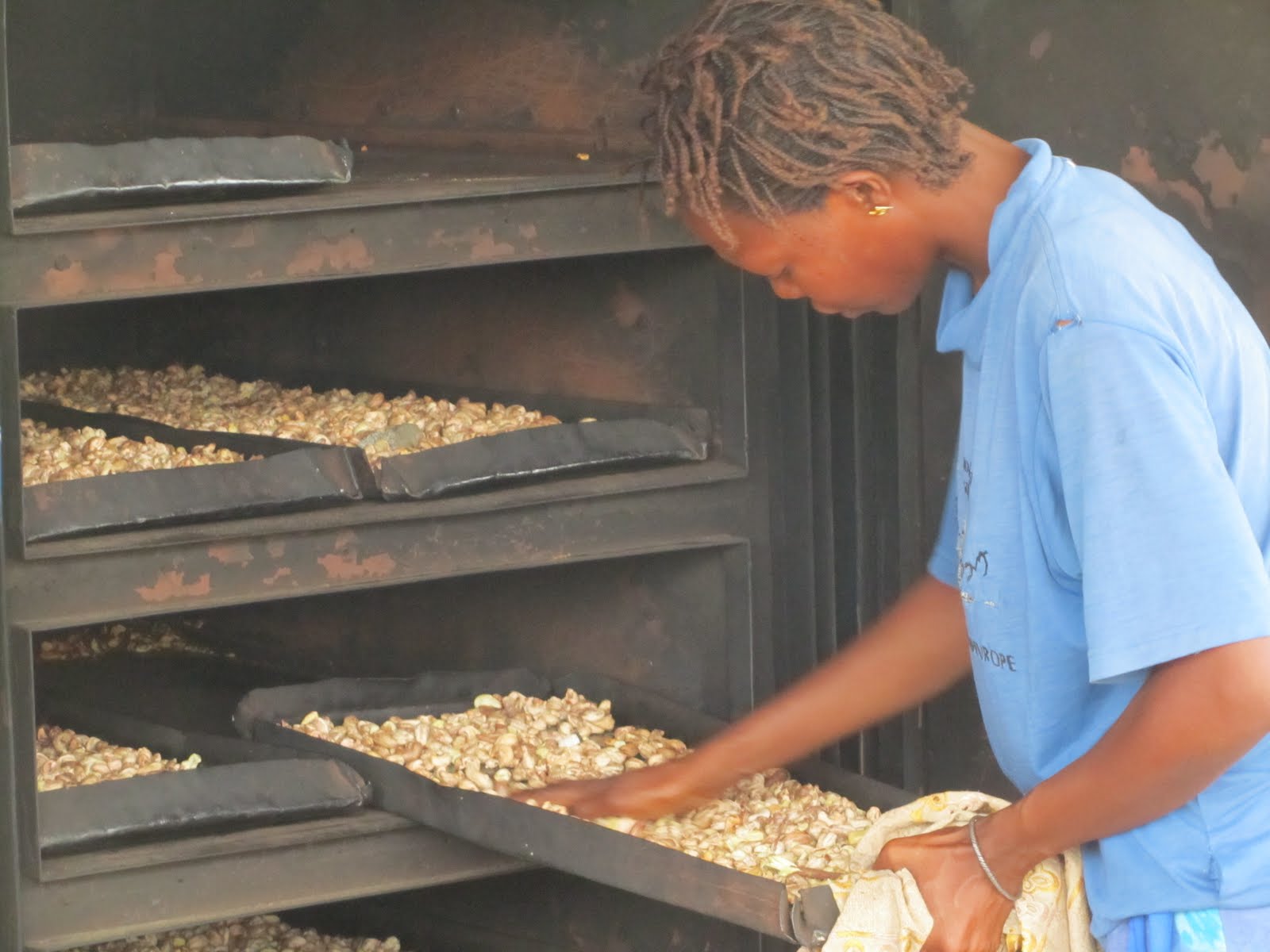
After this trek and the weekend mentioned in Water with a Hint of Goat, our women and a few of my IRD coworkers trekked to Senegal to see how women process cashew there.  A 12 hour road trip later, we sat, watched, and talked to women who had been processing cashew their whole lives. Let me reiterate, everything about the cashew is difficult to manage even with $100,000 dollars of processing equipment; these women have been doing almost all of it by hand: cooking it in a wood fired oven to soften the shell, cutting it by hand, putting it back in the wood fired oven to roast, and then peeling the outer covering off the nut.  Listening to how they managed their business will hopefully help these women construct their own business in a way that runs efficiently.  The BIG problems that must be faced, is the concepts of time, charity, and responsibility.

Malik, my IRD counterpart who works in the villages.
Time – In the Gambia, not everyone really knows what time it is due to lack of watches and literacy, and everything runs very slowly, sometimes people are late by days.  Problems like this in reference to business are obvious, if you have sign a contract saying you will provide cashew nuts by Wednesday being a few days late is a big deal.  Here if you say there is a 4pm meeting, people show up at 6pm.

Moise, my manager, on our trip in Senegal, explaining some of the cashew business and asking questions of the women who work there.
Charity- In the Gambia things run on sharing and credit.  People lend out things, forgive others of their debts, and ask the more fortunate for hand outs.  To the extreme of Muslim concepts of giving out charity (which is a huge part of the religion), this instead breeds a system of not paying for things on credit, laziness, and incessant borrowing.  We are really afraid that others in the village may try to just ruin the business inadvertently by constantly asking for some of the money coming into the village through this new business.
Peeling the outer cover off the nut after it has been cooked, cut, and roasted.

Responsibility- Here the responsibility is to the family and community to the extreme.  In a very collectivist way, people here miss meetings and business opportunities because there is a naming ceremony in the village for the consistent stream of babies here that are born in high volumes, and they will not come if the lunch has not finished cooking or they get lost in the cleaning or daily plowing.

A woman prepares nuts to go into the oven

We are trying to impress that things must have consequences because the business will fail if your workers are two hours late, hand out your money, or just don’t show up. In a society where these values have been ingrained from birth, it will be difficult.


Checking to see if the nuts are evenly cooked

I am coming to realize I am one of the luckiest Peace Corps volunteer in world; my assignment to an NGO as an agribusiness consultant gives me two years of experience internationally in business and non-profit preparing me perfectly for my next step in life.  At the moment, my current plan is for going back for some combination of a MBA and/or master’s degree in international development.  I am learning so many things about importing and exporting, supply chain management, and small scale entrepreneurship. I just want to say, that despite the cultural and social challenges, Peace Corps has been the best choice of my life. Thank you everyone back home for keeping in touch and being so supportive of my journey.


Spend the day in Peace


Friday, July 15, 2011

Water… with a hint of Goat


When I pulled out the first bright yellow bidong of water from Scott’s well, I immediately knew something was amiss.  The water was grey and smelled of a rotting swamp where mass burial has occurred.

 “Oh my, what is that smell?” I exclaimed in disgust.
“It’s a goat.” Scott replied.

Scott explained that a few weeks ago well no one was around, a goat made its way through the garden fence and probably became curious as to the strange concrete structure that stood a foot above its own eye level.  It promptly launched itself up to see what was on top and discovered…nothing. Scott being on the boarder to Senegal lies far from the river and the water table is very deep.  So the goat had about 40 meters in free fall to contemplate why goats can’t fly.  The result?  Bits of hair, fur, and rotting goat skin pulled up continually for weeks.  It took a few days to fish the goat out with cage like contraption but by then the goat had really funked up the water. 

Despite watering the garden with “Goat infused water” my time visiting my friend was enjoyable.  I pruned Cashew trees (with cheap machetes!), planted some pigeon peas, and disappointed a lot of the locals who hoped I spoke Fula (Scott lives in a Fula village) but could only produce the guttural Klingon verbage that is Wolof.  Here the people subsist off of rice, coos, baobob leaf, and when available small amounts of fish.  This reminds me that while I do not get some of the unique cultural benefits of living directly in the village with a host family, I do get a much greater level of nutrition that keeps away the vitamin and protein deficiency that many of my fellow village mates must deal with when consuming a dinner of coos moistened with water and a few bites of added fish. 
Scott's village
Said Small boy
I did bond with a small boy.  After hanging out with him for a few days he began begging me to use my camera...so I told him if he caught a goat he could use my camera.  A few minutes later goat in hand, I let him have the camera.  Not knowing what to take pictures of we had a goat photo shoot and maybe things got out of hand…

Step one catch goat
Step two add goat to every picture you take


This picture may come back to haunt me some day...
Scott, his host sister and cat "Carlos"


An even better picture when you sneak up from behind and add a goat...


Scott's compound, where his host sister pounds coos for dinner


Tiny Momodu always has food on his face and has the talent for high pitch screaming


Little girls everywhere carry full buckets of water on their water on their heads, they weigh perhaps 40  pounds

Scott's host mom
These pictures hopefully give a sense of village life aside from the goat pics. I hope that they help provide some experience of culture and emotion from a far away place.

I am exhausted from getting back from a trek to Senegal.  I am going to write a long post next week on my work as I have had a wonderful and rewarding time helping women in the village learn about business, while myself continuing to learn about the culture and the cashew.

We spend the day in peace,
(Nu Endoo Chi Jamma)